

1. The Self-Driven Child by William Stixrud, PhD and Ned Johnson
2. 告别吼叫, 让孩子自动自发成长 – 黄导 著
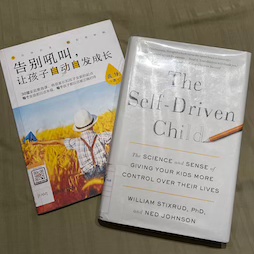
I’ve got 2 boys – a 12 year-old and a 10 year-old. Lately it is becoming obvious that their rebellious bursts are no longer as easy to deal with as when they were younger. Being authoritarian and laying down the rules no longer seemed to work. So bookworm me went to the library to look for answers.
It is rare for me to read Chinese books, but the title spoke to me. The title translates into “Say goodbye to screaming, let your child grow on their own initiative”. EXACTLY what I needed! Self-motivation – what a valuable life skill for a child to learn!
I borrowed the book and read it in 2 days. It was surprisingly an easy read for someone who does not normally read Chinese. The book was written in very simple conversational language and the examples were SO relatable and sounded like my everyday household (it was comforting to know that my parenting struggles are not unique). After finishing the book, I sought a second opinion, this time a book in English and one that received a 4.7 rating out of 1,000+ reviews on Amazon – The Self-Driven Child.
The lessons from both books were similar, summarized as follows:
- Recognize the difference between inner motivation and outer motivation – it is important to drive inner motivation as outer motivation may disappear and is not sustainable. We cannot police our kids for life. Our role is to teach them to think and act independently, so that they will have the judgment to succeed in life.
- Self-driven growth promotes the mentality of “No matter the circumstances, I am responsible for my own outcome” and builds a more resilient child.
- Cultivating self-drive in your child hinges on the following core elements: a) Let the child be responsible for his or her own behaviour and b) As parents, guide not control. Give your child enough freedom and respect to let them figure things out for themselves.
- Instilling ownership for behaviour means
- Identify the things that your child must do on his or her own e.g studies, select household chores, forming friendships
- When it comes to the things that your child must do on his or her own, don’t control and don’t interfere. Instead, guide with love and trust.
- Don’t judge
- Don’t over-indulge
- Recognize the full picture and see both sides of the story
- Understand the needs behind the behaviour and address those needs
- Without a sense of self-control, children feel powerless and overwhelmed and will often become passive or resigned.
- Building self-confidence in children goes back to the growth mindset – less praising the outcome and instead offer more congratulations on his or her growth and effort. Instill a strong sense of self-worth and identity in your child by believing in him or her and build a sense of security for them. Remind your child of the big picture and what really matters.
- Calm is contagious – be a non-anxious parent by
- making enjoying your children your top parenting priority
- not fearing the future
- managing your own stress
- making peace with your worst fears
- adopting an attitude of non-judgmental acceptance
Since reading these books, over the past month I’ve tried to live these lessons. I’ve let go of my fixation on grades and left my boys to plan their own revisions. I’ve also given up control over their phone usage and let them manage their own time. The hope being that they learn self-discipline and self-control, and understand that they are accountable for the outcome.
IT IS HARD. I don’t think they spend enough time on revision and spend too much time on their phones. Every day and every hour I have to stop myself from nagging at them. I remind them often to focus on what’s important (aka STUDIES) – they understand and I know they want to do better but struggle to withstand the temptation of their phones. But our interactions have become more positive, less stressful and they put up less resistance from them when I ask them to do something. So maybe them feeling respected and more in control does help.
Parenting is a tough journey and it takes many iterations to get it right. We as parents have to keep on learning and experimenting to find the right way. Let me know what works for you!

 Rin Ranger