

by Chip Heath and Dan Heath
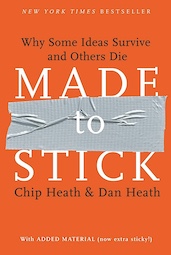
If you are looking to improve your writing, I highly recommend this book.
What makes some ideas stick in your mind and some so easily forgotten? Are ideas born interesting or made interesting? It’s easy to come across guides on the delivery of an idea – presentation skills, body language, etc, but few talks about how to structure your content to get your message across. This book does that.
According to the authors, ideas that stick in people’s minds embody the “SUCCESs” traits:
- S – Simplicity: Strip an idea down to its core.
- U – Unexpected: Surprise captures attention and interest keeps attention.
- C – Concrete: Concrete language is a universal language that helps people understand new concepts.
- C – Credibility: Sticky ideas have to carry their own credentials. Help people test the idea for themselves.
- E – Emotions: Self-interest shapes what people pay attention to.
- S – Stories: Stories provide simulation (knowledge about how to act) and inspiration (motivation to act). The right stories make people act.
Review
I love this book. I borrowed this e-book from the library and halfway through I was looking online to buy a copy. This is definitely one that you should have on your bookshelf and to return to time and again to improve your writing.
What’s really amazing about the book is that after reading the entire book, you will come to realize that the authors have indeed applied the SUCCESs principles throughout the book. The book was written in simple language, using concrete terms, and stories were used liberally to illustrate the points. The stories kept my interest and therefore my attention throughout the 400+ pages.
While shopping for the book on Amazon, I came across one review saying that the book could have been much shorter if not for the many stories. The reviewer thought the stories were too much filler for the simple concepts. I disagree. I think the detailed stories created hooks that made the principles stick in the reader’s mind – exactly the point the authors were trying to illustrate.
Coming to the end of the book, it was a nice surprise to find a summary of all the points covered in the book, along with the accompanying stories. This provided a useful recap and wrap-up.
I found the knowledge practical, and immediately found myself being more conscious about burying the lead in the emails that I write. Having said that, writing is an art which is probably never perfected, so it’s worth keeping a copy and revisiting this book once in a while as a reminder of the principles of good writing.

 Rin Ranger
One thought on “Reading Journal: Made to Stick”